title

title
Photo by Don Kellogg
Showing posts with label Bob Stillman. Show all posts

Saturday, April 19, 2014

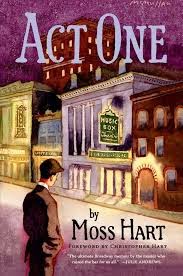
Act One

Let me state right off the bat - I'm no theatrical historian.  I know very little about Mr. Moss Hart except what I've seen of some of his work.  (For more info on Mr. Hart, start here).  For knowing very little, my experience in the theatre this fine weekend afternoon was one of storytelling at its finest.  Two superb actors and a company of over 20 graced the thrust and rotating stage at Lincoln Center's Vivian Beaumont Theatre to regale the audience with a heartwarming and thoroughly entertaining story.

Mr Hart's autobiography by the same name, Act One, is apparently very closely followed in the stage version which was written and directed by James Lapine.  If I had anything at all negative to say (and others have too) is that at almost 3 hours, it's a tad bit too long. For a story partially about Mr. Hart co-developing his first play, Once in a Lifetime, a play that ultimately toys with nixing a 3rd act, ironically this one runs practically as long as a 3 act play.  In my background reading both in the playbill itself and on-line - it seems that Mr. Hart himself may not have been entirely pleased with this fact too.  But I digress...

Tony Shalhoub and Santino Fontana both play Moss Hart - Santino, the younger; Tony, the older.  Both break the 4th wall regularly to narrate and explain the story or set the scene further.  The technique of storytelling from Mr. Hart's youth to the ultimate production of his first play makes for quite a lot of ground to cover. Mr. Shalhoub and Mr. Fontana work tirelessly - some of it literally on Mr. Shalhoub's part just to change characters as he also plays Mr. Hart's insufferable father and playwright George S. Kaufman too.  Andrea Martin does triple duty as Moss' Aunt Kate who first inspired him to pursue the theatre, Freida Fishbein a theatre professional, and Beatrice Kaufman, wife of George.  It's a treat that she was not wasted and we got to enjoy her comedic genius from start to finish.  The entire ensemble, including his family, his chums, theatre producers, actors, maids, audience members, and others turns in thoroughly synchronized and spot-on supporting ensemble roles.

The set was fantastically impressive - literally a carousel built on the Viv's turntable, constantly rotating to change scenes as the actors briskly navigated the pathways and staircases.

Messers Shalhoub and Fontana are the heart and soul (pardon the pun) of this entertaining show.  It's a tale of rags to riches told in the most tender and endearing way without being cliche or overbearing.  I sure hope they, if not Ms. Martin too, are recognized at the Tony Nominations this year.

It would be a coup for a show about a man who wrote and directed award winning shows to win an award itself.

Wednesday, December 12, 2012

A Civil War Christmas

Paula Vogel has penned a historical perspective on an age-old tradition - Christmas.  Her version is a dramatic triptych on the holiday which takes place during the civil war.  Each of the 3 main plot perspectives share equally in the joy and sadness of the historical holiday - smack in the middle of the civil war - Stories from the North, the South, and the always steady Abe and emotionally unstable Mary Lincoln centrally located in the White house.

It's not quite a musical but more of a play with music - but less-so a play and more story-telling theatrical experience. The music was all Christmas carols cleverly placed throughout the scenes.  All the fine actors in full regalia and costumes played multiple characters with little-to-no scenery - merely a few props and chairs upon which the fine actors created an entire landscape and mood.  

Of all the extremely talented actors, the one stand-out performer was Jonathan-David (yes, i correctly hyphenated his "name") as Ely Parker, Silver, Frederick Wormley, Moses Levy and others.  Clearly a trained dancer, a fine improv actor, and vocally impressive.  A stalwart and stubborn Mary Lincoln was played with Aplomb by Alice Ripley.

Having already seen Lincoln (Daniel Day Lewis) on the big screen just the weekend before and seeing this show just before Christmas put me in just the right mood.  I doubt this one would go over very well in August, but certainly a heart-warming, entertaining history-lesson on the small stage down at the New York Theatre Workshop on East 4th.

Saturday, October 28, 2006

Grey Gardens

Grey Gardens is Christine Ebersole's show to shine in. And boy-oh-boy - did she ever! This recent transfer to Broadway is the story of Edith Bouvier Beale, her daughter, Edie, and their extreme relationship. The show is filled with wealthy family drama, the back-story of their connections to the Kennedy Clan, their extreme transformation with age, and of course a good dose of music - something Edith herself used to fill the many voids in her life.

Act I portrays the gay days (taken both literally and figuratively!) of the family in 1941 at the Beale Summer House - Grey Gardens - out in the Hamptons. This is the time period that young Edie meets and almost marries a young Joe Kennedy. Christine plays Mother Edith - the strong willed, powerful, yet extremely vulnerable matriarch of the Beale Family (while her husband is off fooling around on Wall Street and cheating on his wife). Kudos go out to John McMartin who plays a wonderfully entertaining Father to Edith - Major Bouvier.

In Act II Christine transforms herself into her own daughter - and Mary Louise Wilson takes over as her aging Mother in 1974 - - in what can only be described as the extreme decline of Grey Gardens. She is a recluse, the house is falling apart and they are both quite eccentric and have become locally infamous for the squalor they live in - - So much so that Jackie Bouvier Kennedy Onassis actually made several public statements on the situation of her aunt and cousin.

The quick witted and sharp tongued Ebersole tears thru both acts with gusto. Showing us at first her desire as Edith to impress and entertain - and then later her personal struggle as Edie with having her life "ruined" by her mother. In the end - she's not strong (or sane) enough to leave - despite her regrets, anger, and desire to do so.

The feelings of gaiety and lyrical music turn to hopelessness, desperation, and squalor in a mere 3 hours on Broadway at the Walter Kerr Theater on West 48th.