Staged like a reading, the actors sit in a line in front of their laptops frantically sending messages, reading them aloud as fast as they can type them. Despite the simple and repetitive nature of the staging, the show finds many moments of hilarity in the relationships the cyber world spawns and the freedom that faceless, often comical, communications it seems to encourage. One of my favorite characters (and that is indeed a perfect word here) is George and his cyber abbreviation malapropisms. He turns LMAO into "laughing my face off" and TTYL into "talk to you soon". After you catch on that he didn't just screw up a line, you'll be salivating for the next. Van Zandt and Milmore's production could use a few cuts and maybe one less "act", but in the end - if you're in the mood for a few cocktails and a bunch of computer based chuckles, google this one and book yourself a seat on line.
title
Photo by Don Kellogg
Friday, November 19, 2010
You've Got Hate Mail
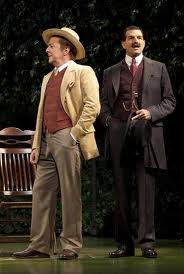
Billy Van Zandt and Jane Milmore wrote and star in this screwball comedy playing at The Triad involving sex, lies, and most importantly, laptops. Mis-directed chat messages, emails, and fake identities run amok among Richard the cheating spouse (Billy Van Zandt), Stephanie the naive suburban housewife (Jane Milmore), Peg the eternally single friend (Barbara Bonilla), George the dirty minded boss (Glenn Jones), and Wanda an office bimbo (Fran Solgan).
Staged like a reading, the actors sit in a line in front of their laptops frantically sending messages, reading them aloud as fast as they can type them. Despite the simple and repetitive nature of the staging, the show finds many moments of hilarity in the relationships the cyber world spawns and the freedom that faceless, often comical, communications it seems to encourage. One of my favorite characters (and that is indeed a perfect word here) is George and his cyber abbreviation malapropisms. He turns LMAO into "laughing my face off" and TTYL into "talk to you soon". After you catch on that he didn't just screw up a line, you'll be salivating for the next. Van Zandt and Milmore's production could use a few cuts and maybe one less "act", but in the end - if you're in the mood for a few cocktails and a bunch of computer based chuckles, google this one and book yourself a seat on line.
Noteworthy Talent:
Barbara Bonilla,
Billy Van Zandt,
Fran Solgan,
Glenn Jones,
Jane Milmore
Tuesday, November 16, 2010
Elling
Something told me as soon as the curtain went up - this is not an American play. (Maybe if i noticed the date and place atop the huge diary entry scrawled on the curtain I'd have realized this too). Instead, a sparse stage with Ikea-looking furniture clued me in. Indeed, the play was written by someone from and takes place in Norway . The subject matter is a bit odd, but enjoyable nonetheless - Two men get released from a mental hospital into what we Americans might call a half-way house. They are not dangerous people and the show is a comedic, mis-hap laden, and touching chronicle of their rehabilitation and re-introduction into society.
Dennis O'Hare (Elling) and Brendan Frasier (Kjell Bjarne) certainly have chemistry and it instantly permeates the air as the two odd-ball men engage in their banter. If an American TV series were to be spawned from this play, it might be aptly titled The Odd Odd-Couple. Richard Easton (Alfonz Jorgensen) and Jeremy Shamos (Frank Alsi) also rounded out the cast but frankly didn't provide much to the overall hilarity of the story itself. The magic formula for this show lies squarely on the shoulders of O'Hare and Frasier. I'm not convinced, however, that Jennifer Coolidge (Reidun Nordsletten) is even certified to be up on stage, nonetheless with these two stage pros. Her performance was often stilted (Gunn) and even confusing at times (Reidun).
There were quite a few laughs and after I warmed up to the idea of the show, I must say I enjoyed it thoroughly. A few surprises break up the action including the poetry-slam scene in which Shamos had a show stealing moment and the restaurant bathroom scene where Elling meets Alfonz - let's just say the sound effects stole that one. Note to readers: the next time you buy sauerkraut, look inside the package. Like Elling, you might just find a pleasant surprise inside.
Noteworthy Talent:
Brendan Frasier,
Dennis O'Hare,
Jennifer Coolidge,
Jeremy Shamos,
Richard Easton
Monday, November 15, 2010
Edgewise
I love going to see plays downtown. Downtown. That's shorthand for plays that take risks, aren't full of makeup and costumes, and really showcase the artists' talents. Edgewise, Eliza Clark's new work now being performed at WalkerSpace in Soho, is just one such play that just might rip open your mind and explode itself all over your evening. (um, I mean that in a good way).
Youth, rebellion, bullying, anger (lots of anger), romance, and an undefined active war on US soil are just a few of the subjects that fill the afternoon a dumpy suburban New Jersey burger joint named Dougal's. Philip Ettinger (Ruckus) and Tobias Segal (Marco) take center stage along with Aja Naomi King (Emma) as the unsuspecting teen workers at the joint concerned with the usual age-appropriate things when Alfredo Narcisco (Louis), a bloody man, stumbles in the front door after an apparent attack outside and a stranger (Brandon Dirden) wanders in for a burger . Where their individual emotions, suspicions, and prejudices take them is the fuel that makes the engine of this play fire on all cylinders. It's raw. It's powerful. It's not perfect.

Sometimes plays aren't all sunshine and lollipops. Due to the graphic violence, I doubt we'll be seeing this one transferring to Broadway for a commercial run any time soon, but it doesn't mean you won't be deeply moved and you might even think about the subject matter after you leave the theater. You might even recommend the play to a friend. I was. I did. I do.
Youth, rebellion, bullying, anger (lots of anger), romance, and an undefined active war on US soil are just a few of the subjects that fill the afternoon a dumpy suburban New Jersey burger joint named Dougal's. Philip Ettinger (Ruckus) and Tobias Segal (Marco) take center stage along with Aja Naomi King (Emma) as the unsuspecting teen workers at the joint concerned with the usual age-appropriate things when Alfredo Narcisco (Louis), a bloody man, stumbles in the front door after an apparent attack outside and a stranger (Brandon Dirden) wanders in for a burger . Where their individual emotions, suspicions, and prejudices take them is the fuel that makes the engine of this play fire on all cylinders. It's raw. It's powerful. It's not perfect.
Sometimes plays aren't all sunshine and lollipops. Due to the graphic violence, I doubt we'll be seeing this one transferring to Broadway for a commercial run any time soon, but it doesn't mean you won't be deeply moved and you might even think about the subject matter after you leave the theater. You might even recommend the play to a friend. I was. I did. I do.
Noteworthy Talent:
Aja Naomi King,
Alfredo Narcisco,
Brandon J. Dirden,
Philip Ettinger,
Tobias Segal
Saturday, November 13, 2010
Mrs. Warren's Profession
Deception, lies, money, bribes, love, lust, an illegitimate child, prostitution... and that's just the first act! George Bernard Shaw's world in 1893 wasn't far off from our own today. Difference being, all he had was a pen, a stage, and actors to tell a provocative story his audience could see and hear no other way. Shaw was a big believer in theatre that engaged the audience in the issues of the day rather than letting them escape from them - hence this stinging work he penned.
Set in four equal acts, the show depicts Vivie Warren (Sally Hawkins) as the young, well educated, pragmatic daughter of Mrs. Kitty Warren (Cherry Jones) who, in her coming of age, finds out that her entire upbringing and education was funded by her mother's secretive business endeavor - Brothels. She briefly reconciles with her mother after coming to terms with the reasons her mother turned to such a life, but then quickly rebukes her after she realizes that the secretive business is not just a faded memory, but an ongoing operation. Throw in a dirty older gentleman business partner (Mark Harelik) who seeks an "arrangement" to marry Vivie and keep the entire operation within the family, a dashing young suitor (Adam Driver) with no money who wants to marry Vivie for love (and her money), his father (Michael Siberry), the local vicar who strangely rejects the idea of his son's marriage to Vivie for suspicious "reasons undisclosed", and a worldly, trusted friend (Edward Hibbert).
Unfortunately, I don't think this play is going to be a Tony contender, although it surely entertained. Jones is a powerhouse on stage, a force to be reckoned with. However, Hawkins seemed to be screaming all the time rather than exuding her "power of the new age woman" - proud, educated, professional, independent, and ethically sound - as I believe Shaw meant the part to be - - a complete counter-weight to her mother's character. The men on stage turned in sound performances, and certainly seemed to be enjoying their roles in this turn of the 19th century Payton Place drama.
I must say, despite some minor flaws i may have mentioned, I thoroughly enjoyed the show - I think more because of the story itself than the specific actors. Shaw was a realist and this play contained real issues of the day (one might argue they are timeless). At the end of the day, anything with Cherry Jones is worth seeing and almost anything at Roundabout Theater is worth seeing - a combo that, just like a steamy night at a red hot brothel, can't be passed up.
Noteworthy Talent:
Adam Driver,
Cherry Jones,
Edward Hibbert,
Mark Harelik,
Michael Siberry,
Sally Hawkins
Monday, November 8, 2010
Pieces
The British invasion has arrived. Each year 59E59 Theaters hosts Brits off Broadway - a theater festival chock full of shows of all forms, sizes, and shapes from across the pond. Pieces is a brilliantly disquieting work by Hywel John staring 3 British actors who grace the intimate stage for 90 minutes of non-stop intensity.
From the get-go, Steven Meo (Jack), Louise Collins (Beatrice), Jennifer Kidd (Sophie) weave an eerie and well-acted tale. At first blush it seems a simple sad story - Jack and Beatrice, two young children, have lost both their parents (seemingly in a car accident by the screeching tires we hear in the dark as the lights come up).
The deeper we dive into the mysterious life of these twins who are isolated in the British countryside with their god-mum, now guardian, an eerie, bizarre tale unfolds. The seemingly innocent, well-raised children are adamant about preserving the memory of their parents - wearing their clothes, repeating their words and phrases and, with grave consequences, attempting to re-enact their life - Picking up the pieces and moving on, as it were. What they attempt is the literal, but what we see is how that literal is not fully understood by the child's mind. Though this odd behavior we see the relationship between the adult and children progress as the days wear on. When Jack learns a secret about Sophie, we see the tale take a bizarre journey to a shocking and unsettling end. Applause at the end seemed inappropriate, yet very well deserved.
Noteworthy Talent:
Jennifer Kidd,
Louise Collins,
Steven Meo
Wednesday, November 3, 2010
The Break of Noon
Neil LaBute's new play is vague. Was I supposed to walk away thinking this guy was a a phony? He faked it? Or was I supposed to walk away snickering to myself about how awful society is and how if one man claims to have found religion, we rebuke him? Well, to tell the truth, I, along with several heretofore unacquainted theatergoers, I walked away asking for the 100 minutes we invested back.
David Duchovny (John Smith) was flatter than a penny after being run over by the #1 train. I couldn't tell what he was trying to emote. The two ladies in the cast turned in decent but generally unremarkable performances - Amanda Peet (Ginger/Jesse) and Tracee Chimo (Jenny/Gigi). The only actor who impressed was John Earl Jelks (Lawyer/Detective). He had a presence and a power on stage that none of the other actors seemed to be able to summon. Peet, as Jesse, came close near the end but the poorly directed character she was playing just got in the way. Great Long Island accent, however.
So, I'm wondering the whole time what LaBute was trying to convey here - and along comes this last, incongruous scene where we are presumed to be watching John go "evangelist" to get his message out - and it ends with him levitating. Levitating? WTF?
The play was in that dump, The Lucille Lortel Theatre, in the gay ghetto on Christopher Street, which didn't serve to improve my mood any either. I wouldn't rush out to see this one. Unless you need a nap in a bad seat. Don't worry, the play won't wake you.
Noteworthy Talent:
Amanda Peet,
David Duchovny,
John Earl Jelks,
Tracee Chimo
Sunday, October 31, 2010
Angels in America - Part Two: Perestroika
I believe this two part opus by Tony Kushner is powerful no matter how it is viewed. I chose to view it sequentially in one day - Saturday - a 3 hour Part One at 2pm and a 4 hour Part Two at 8pm. While most may consider this a long day in theatre - it could alternatively be viewed as a unique immersive experience. Taking a break of several days or weeks between the two parts is not a bad thing - but if you can handle it, the rewards of the 7 hour marathon are well worth the sacrifice. The show is being performed in repertory at the Signature Theater for the entire run with both Wednesdays and Saturdays being the opportunities for the marathons and all other days the single plays alternate with regularity.
Part Two: Perestroika continues on exactly where Part One: Millennium Approaches leaves off - New York City 1986. At the end of the first play, Prior Walter is visited by the angel in an emotional and theatrically compelling scene. The concept of fantasia is only a flirtation in the first play, but is fully exploited in the second. As the latter play unfolds, Kushner uses the powerful devices of theatre and the fantasia to lay out his theories of God, heaven, and humanity. Without going into the specifics, Kushner presents to us the idea that, yes, there is a God who created the universe and there are angels. But his twist on the idea is that the angels are actually lost. God left us. The Angels are waiting for him to come back but humanity is moving ever faster and forward, creating more and more social problems, political schisms, and global conflict. The angels want us to slow down, stop migrating, and wait for God to return so that harmony can be restored. Wow.
After 7 hours, I was emotionally exhausted and intellectually drained, but not so much that I couldn't walk away hopeful and optimistic. Kushner's play is a brilliant work of our time and the fine actors on stage at the Signature Theatre provide it the voice he intended it to have.
Part Two: Perestroika continues on exactly where Part One: Millennium Approaches leaves off - New York City 1986. At the end of the first play, Prior Walter is visited by the angel in an emotional and theatrically compelling scene. The concept of fantasia is only a flirtation in the first play, but is fully exploited in the second. As the latter play unfolds, Kushner uses the powerful devices of theatre and the fantasia to lay out his theories of God, heaven, and humanity. Without going into the specifics, Kushner presents to us the idea that, yes, there is a God who created the universe and there are angels. But his twist on the idea is that the angels are actually lost. God left us. The Angels are waiting for him to come back but humanity is moving ever faster and forward, creating more and more social problems, political schisms, and global conflict. The angels want us to slow down, stop migrating, and wait for God to return so that harmony can be restored. Wow.
The conflict presented in the fantasia and in parallel in real life in politics, religion, and society is that we can't do what the angels in the fantasia want. As Prior Walter ultimately does reject the angel's proposal in the fantasia - so does he reject the idea in real life too. He does not accept his boyfriend back, instead he moves forward. He does not initially accept the AZT medicine for his disease, but he does move forward (whether or not he eventually does, one can only speculate), Joe's mother rejects her hateful religious beliefs and moves forward a more enlightened human. Most of all life itself moves forward.
After 7 hours, I was emotionally exhausted and intellectually drained, but not so much that I couldn't walk away hopeful and optimistic. Kushner's play is a brilliant work of our time and the fine actors on stage at the Signature Theatre provide it the voice he intended it to have.
The great work has already begun.
Noteworthy Talent:
Bill Heck,
Billy Porter,
Christian Borle,
Frank Wood,
Robin Bartlett,
Robin Weigert,
Zachary Quinto,
Zoe Kazan
Saturday, October 30, 2010
Angels in America - Part One: Millennium Approaches
To be precise the full title of the play is Angels in America: A Gay Fantasia On National Themes. We tend to leave off that last part and I believe with the passage of time, that portion of the title holds an ever more important role in explaining the nature and purpose of the play.
The play is a 7 hour opus divided into two independent plays of equal length often performed in repertory. Part I: The Millennium Approaches takes place in 1986 New York City and introduces us to 3 overlapping story-lines - a young gay couple one of whom reveals he has AIDS; a tough as nails, un-stereotypically gay power-attorney diagnosed with AIDS; and a troubled Mormon couple recently relocated to New York City. As Part I unfolds, it is revealed to us just how entangled these stories are about to become as the Millennium (both lower case m and capital M) approaches.
If the play were merely about these 3 plot-lines, this work would have been turned into a soap opera running on Lifetime Television every night at 9pm. However, Tony Kushner's opus is contextually much deeper. It thrusts the visceral socio-political thorns in America's side in 1986 to the forefront - specifically homosexuality, Ronald Reagan, AIDS, racism, conservatism, and the religious right and what it means to be an American in the context of history, religion, and modern day politics. In some ways, the play is not about the actual characters themselves. Again, the second part of the show's title: A Gay Fantasia on National Themes, is truly the point. This play is a documentary of an era, a sermon, a call to action. The use of fantasia serves only to enhance the message, provide a rich context, generate conversation and spark dialogue.
The choice of the very intimate setting of the Signature Theatre - Peter Norton Space was a brilliant staging decision. With some assistance from panoramic video projections and a very vibrant sound and lighting system (Ken Travis and Ben Stanton) they are able to transport the audience to the multitude of locations with the seemingly simple rotation of the box-like sets (Mark Wendland) that were most definitely complex under the hood. This leaves the power of the show to the spoken words and underlying concepts. What about the cast, you ask - without a doubt it is simply top notch. As customary with this work, the cast plays multiple characters - and often those choices of who plays which alternate character are, themselves, a clever social commentary all in themselves. Kushner's opus fires on all cylinders and attacks on all fronts.
Christian Borle gives a tremendously emotional, and vibrant portrayal of Prior Walker. In his New York debut, Zachary Quinto plays a superbly analytical, emotionally torn Louis Ironson. Billy Porter, as Belize, shows us a defiantly gay and deeply loyal Belize. Frank Wood quite possibly has surpassed all others, including Al Pacino in the HBO mini-series, in his portrayal of Roy Cohn - striking the perfect balance of anger, intellect, hypocrisy, and arrogance.
Noteworthy Talent:
Bill Heck,
Billy Porter,
Christian Borle,
Frank Wood,
Robin Bartlett,
Robin Weigert,
Zachary Quinto,
Zoe Kazan
Thursday, October 28, 2010
The Language Archive
Asian American Julia Cho's new play, The Language Archive, is a surprisingly entertaining and satisfying piece of theatre with a simple message currently playing at the Roundabout Theatre Company's Laura Pels Theatre on West 46th Street. I've seen the play up on the "paper the house" ticket sites that I belong to and assumed it was one of those, you know, marginal plays with a subscription base that wasn't quite pulling its seat filling weight. Well, I was wrong.
George (Matt Letscher) and Mary (Heidi Schreck) are married but something is just not right. George is a brilliant linguist, a scientist of sorts - a preserver and documentarian of languages no longer spoken. Mary is simply unhappy - with life, herself, and being married to George - yet George, the brilliant linguist is at a loss for words when it comes to Mary. Into his laboratory, or library as it were, comes Alta (Jayne Houdyshell) and Resten (John Horton), an elderly couple from a distant land (Uzbekistan-like, by the looks of their humorous frocks) who are the last two speakers of another dying language. He expects to record their conversations and preserve their tongue, but what he gets instead is a lesson in life and love. George's wife leaves him to find herself, Emma (Betty Gilpin), George's assistant goes on a journey to summon the courage to reveal her unrequited love for him, and Alta and Resten fight (in English) like you'd expect an old married couple to do.
Cho has brilliantly woven the fabric of the characters together, an overlapping pattern of sorts. Each of them experiences something unexpected in their life and each of them learns from the others both through direct dialogue and indirectly through circumstance and observation. In the end, Cho's message is not about language at all, it's about love - the many different types of love and how not everyone may end up loving the way they expect.
Mark Brokaw's direction was smart and the grand moving bookcase sets by Neil Patel set the perfect mood and atmosphere for the story. Overall, this play was quietly powerful. No guns, no strobe lights, no 3D effects - just an enjoyable evening in the theatre with an honest message about life. Thank you Julia Cho.
Noteworthy Talent:
Betty Gilpin,
Heidi Schreck,
Jayne Houdyshell,
John Horton,
Matt Letscher
Wednesday, October 27, 2010
Perfect Harmony
A gleeful (pun intended) trip down the high school vocal club lane. Andrew Grosso and The Essentials (a group of other actors and singers) penned a little glee-club-like drama back in 2006 (before there was Glee). Unfortunately, the comparisons today abound. And unfortunately for the stage show today, Fox television and their million dollar production budget does it much better. Let me be clear - this is not a prequel to the TV series, just a similar concept.
Frankly, I enjoyed this stage production immensely. First of all, it's primarily about the Acafellas (an all boys a-cappella singing group), not a glee-club that miraculously transforms into a full stage and recording studio production event periodically throughout the show. Am I a bit tired of the over-the-top "camp" with the singing stuff - yeah, maybe. But if you can put the constant comparisons to today's TV hit, you just might find this stage production storyline quite enjoyable.
Make no mistake, this show is cast with actors who can sing. In contrast, another recent a-cappella off-Broadway show, In Transit, took the opposite approach - a-cappella group singers who can act. I think it makes a big difference in your musical and theatrical experience. On a related note, I'm not sure if I should call this a comedy (as the broadwayworld.com does), a play with music, or a musical. But I digress...
The cast, as expected, is composed of a wonderfully eclectic, quirky, and off-beat group of high school vocal mis-fits with an wide assortment of social, medical, and family problems - one hot jock who sings (Jarid Faubel), one groovy black girl (Kelly McCreary), one prim and proper white girl (Dana Acheson) one Asian girl with Tourette's (Marie-France Arcilla), two boys clearly from rich families as evidenced from the roman numerals after their names (Robbie Collier Sublett and Kobi Libii), one uber-geeky freshman (David Barlow), one extremely shy girl who is obsessed with people looking at her (Faryl Amadeus), one boy who doesn't speak and only sings (Clayton Apgar), and one Herzegovinian orphan (Kate Morgan Chadwick) ... along with a multitude of alternate characters the actors take on to round out the storyline. What brings them all together? Music and singing. Do we recognize any of them in ourselves? Without a doubt. Do we laugh at them? Absolutely. Do we enjoy the pop songs they turn into a-cappella performances? Immensely.
Take in a performance of this tuner over at Theatre Row in the Acorn Theatre and you might just walk away humming a few popular tunes in a whole new way.
Frankly, I enjoyed this stage production immensely. First of all, it's primarily about the Acafellas (an all boys a-cappella singing group), not a glee-club that miraculously transforms into a full stage and recording studio production event periodically throughout the show. Am I a bit tired of the over-the-top "camp" with the singing stuff - yeah, maybe. But if you can put the constant comparisons to today's TV hit, you just might find this stage production storyline quite enjoyable. Make no mistake, this show is cast with actors who can sing. In contrast, another recent a-cappella off-Broadway show, In Transit, took the opposite approach - a-cappella group singers who can act. I think it makes a big difference in your musical and theatrical experience. On a related note, I'm not sure if I should call this a comedy (as the broadwayworld.com does), a play with music, or a musical. But I digress...
The cast, as expected, is composed of a wonderfully eclectic, quirky, and off-beat group of high school vocal mis-fits with an wide assortment of social, medical, and family problems - one hot jock who sings (Jarid Faubel), one groovy black girl (Kelly McCreary), one prim and proper white girl (Dana Acheson) one Asian girl with Tourette's (Marie-France Arcilla), two boys clearly from rich families as evidenced from the roman numerals after their names (Robbie Collier Sublett and Kobi Libii), one uber-geeky freshman (David Barlow), one extremely shy girl who is obsessed with people looking at her (Faryl Amadeus), one boy who doesn't speak and only sings (Clayton Apgar), and one Herzegovinian orphan (Kate Morgan Chadwick) ... along with a multitude of alternate characters the actors take on to round out the storyline. What brings them all together? Music and singing. Do we recognize any of them in ourselves? Without a doubt. Do we laugh at them? Absolutely. Do we enjoy the pop songs they turn into a-cappella performances? Immensely.Take in a performance of this tuner over at Theatre Row in the Acorn Theatre and you might just walk away humming a few popular tunes in a whole new way.
Tuesday, October 26, 2010
A Free Man of Color
Quite an epic on stage at the Vivian Beaumont Theater at Lincoln Center! Three hours - and chock full of action, education, and quite a few laughs along the way. John Guare's new opus is an ambitious work - as evidenced by the size cast - 26 listed in on the billboard alone and most play multiple characters on top of that!
Guare takes us on a journey to New Orleans in 1801 - which, in case you didn't know, was not part of America at this point in time. It was filled with Spaniards, French, and Caribbeans of all types. New Orleans was a land where men of all shades of color - from white to dark filled the city and shared a grand life. It was a city where a slave could buy his freedom and become the toast of the town - especially among the women (of all colors) of the town. Not only does Guare's play give us a sense of life in this vaudevillian city - he goes further to educate us on the global politics of the (1801) day - teaching us how Spain, France, England and Sante Dominigue (Haiti) all were part of the story of how America came to own this vast new land that spanned westward from the Appalachians to the Mississippi River, from the Gulf of Mexico northward to Canada - and how it changed New Orleans forever.
Jeffrey Wright helms the cast as the main character, Jacques Cornet and gets tremendous support from dozens of actors playing multiple characters in at least 4 different countries. Stand-out performances to be noted: Mos Def (the rapper) as Cornet's slave, John McMartin as Thomas Jefferson, Veanne Cox as Dona Polissena, a scientist, a young Paul Dano as Meriweather Lewis (of Lewis and Clark), and Triney Sandoval as Napoleon Bonaparte - - just to name a few.
Three hours may seem like an eternity - but director, George C. Wolfe, crams enough witty and quick tempo dialogue, colorful costumes, lively action and an abundance of information in to the fast paced, multi-country story that before you know it, 11:00 is here and you're dumped out on the plaza at Lincoln center with all the hoity-toity opera snobs in their tuxedos and gowns. I highly recommend you attend this epic tale before it sells out for the season.
Guare takes us on a journey to New Orleans in 1801 - which, in case you didn't know, was not part of America at this point in time. It was filled with Spaniards, French, and Caribbeans of all types. New Orleans was a land where men of all shades of color - from white to dark filled the city and shared a grand life. It was a city where a slave could buy his freedom and become the toast of the town - especially among the women (of all colors) of the town. Not only does Guare's play give us a sense of life in this vaudevillian city - he goes further to educate us on the global politics of the (1801) day - teaching us how Spain, France, England and Sante Dominigue (Haiti) all were part of the story of how America came to own this vast new land that spanned westward from the Appalachians to the Mississippi River, from the Gulf of Mexico northward to Canada - and how it changed New Orleans forever.Jeffrey Wright helms the cast as the main character, Jacques Cornet and gets tremendous support from dozens of actors playing multiple characters in at least 4 different countries. Stand-out performances to be noted: Mos Def (the rapper) as Cornet's slave, John McMartin as Thomas Jefferson, Veanne Cox as Dona Polissena, a scientist, a young Paul Dano as Meriweather Lewis (of Lewis and Clark), and Triney Sandoval as Napoleon Bonaparte - - just to name a few.
Three hours may seem like an eternity - but director, George C. Wolfe, crams enough witty and quick tempo dialogue, colorful costumes, lively action and an abundance of information in to the fast paced, multi-country story that before you know it, 11:00 is here and you're dumped out on the plaza at Lincoln center with all the hoity-toity opera snobs in their tuxedos and gowns. I highly recommend you attend this epic tale before it sells out for the season.
Noteworthy Talent:
Arnie Burton,
Brian Reddy,
Jeffrey Wright,
John McMartin,
Mos,
Paul Dano,
Peter Bartlett,
Robert Stanton,
Rosal Colon,
Sara Gettelfinger,
Triney Sandoval,
Veanne Cox
Thursday, October 21, 2010
Women on the Verge of a Nervous Breakdown
Wow! And this was only the 13th preview performance. That says a great deal all by itself. What a huge risk this could be. A new, technically and theatrically complex musical opening cold in New York - no out-of-town tryout. Talk about a risky proposition for the producers and investors and not to mention the stars themselves - and there are a lot of them packed onto the stage at the Belasco Theatre. Rest assured, my loyal readers, this one is going to be a great big Broadway hit!
Where to start?! First of all, this show is based on Pedro Almodóvar's 1988 film by the same name. By way of background, you have to know that the style is supposed to be a little cheesy. It's a story presented in the telenovela style - colorful, over-acted, and generally bold. Stop right there. Translating that to the Broadway stage is a feat all in itself. Mr. Sher (director), Mr. Gattelli (choreographer), and the entire production staff have taken on the challenge and presented those three characteristics back to us in virtually every aspect of the production - the lighting, the scenery, the video, the sets and the costumes. That in itself is worthless with the wrong actors. Inside those costumes, under those lights, and on the stage is a an eclectic collection of the most talented actors you might find assembled in one place today. Patti Lupone, Brian Stokes Mitchell, Sherie Rene Scott, Laura Benanti, Danny Burstein, de'Adre Aziza, Justin Guarini, and Mary Beth Peil headline the massive undertaking and seem to defy the notion that there can only be one star in a show. Each of them holds their own but together they are a powerhouse ensemble.

Other than what was written into the script, I never felt any dueling divas on stage. Each of them has their "moments" in the spotlight. All of them complement each other. Ms. Lupone has her bare stage moment in the spotlight along with a show's worth of light hearted Spanish diva moments. Justin Guarini, in his Broadway debut, proves he's got acting chops while getting the opportunity to showcase his amazing tenor voice. Brian Stokes Mitchell fills the theatre with his perfectly pitched, powerfully melodic baritone vocals. Laura Benanti might possibly be the next show stealing comedic actress of the season (ala Katie Finneran in Promises, Promises last season). Sherie Rene Scott takes the lead as a Brunette (most recently we saw her natural blond side in Everyday Rapture) and doesn't fail to entertain the entire show. The entire cast works well together - constantly in motion, constantly in chaos and constantly on queue and pitch perfect.
On a related note, I must also note that this is the first production to be staged at the Belasco Theatre after its extensive and first class renovation. The wood paneled, marble clad and Tiffany stained glass filled theatre has been restored to its full glory and what a marvelous show to use as the vehicle to reveal the fine artistry conceived for theater impresario David Belasco in 1907. Technically speaking, I've never seen a more modern stage. Digital lighting, video projection systems, hydraulics, extensive scenery fly-in capacity and a sound system to rival all others are among the many improvements that are clearly taken advantage of in this production.
Does the show need some work? Of course - no show is perfect out of the gate. Nips and tucks needed here, choreography cleaned up there. But at the 13th preview, this show and all its moving parts is far ahead of where most would be at this point. Women on the Verge of a Nervous Breakdown is cleared for takeoff and we get to enjoy the in-flight entertainment.
Where to start?! First of all, this show is based on Pedro Almodóvar's 1988 film by the same name. By way of background, you have to know that the style is supposed to be a little cheesy. It's a story presented in the telenovela style - colorful, over-acted, and generally bold. Stop right there. Translating that to the Broadway stage is a feat all in itself. Mr. Sher (director), Mr. Gattelli (choreographer), and the entire production staff have taken on the challenge and presented those three characteristics back to us in virtually every aspect of the production - the lighting, the scenery, the video, the sets and the costumes. That in itself is worthless with the wrong actors. Inside those costumes, under those lights, and on the stage is a an eclectic collection of the most talented actors you might find assembled in one place today. Patti Lupone, Brian Stokes Mitchell, Sherie Rene Scott, Laura Benanti, Danny Burstein, de'Adre Aziza, Justin Guarini, and Mary Beth Peil headline the massive undertaking and seem to defy the notion that there can only be one star in a show. Each of them holds their own but together they are a powerhouse ensemble. 
Other than what was written into the script, I never felt any dueling divas on stage. Each of them has their "moments" in the spotlight. All of them complement each other. Ms. Lupone has her bare stage moment in the spotlight along with a show's worth of light hearted Spanish diva moments. Justin Guarini, in his Broadway debut, proves he's got acting chops while getting the opportunity to showcase his amazing tenor voice. Brian Stokes Mitchell fills the theatre with his perfectly pitched, powerfully melodic baritone vocals. Laura Benanti might possibly be the next show stealing comedic actress of the season (ala Katie Finneran in Promises, Promises last season). Sherie Rene Scott takes the lead as a Brunette (most recently we saw her natural blond side in Everyday Rapture) and doesn't fail to entertain the entire show. The entire cast works well together - constantly in motion, constantly in chaos and constantly on queue and pitch perfect.
On a related note, I must also note that this is the first production to be staged at the Belasco Theatre after its extensive and first class renovation. The wood paneled, marble clad and Tiffany stained glass filled theatre has been restored to its full glory and what a marvelous show to use as the vehicle to reveal the fine artistry conceived for theater impresario David Belasco in 1907. Technically speaking, I've never seen a more modern stage. Digital lighting, video projection systems, hydraulics, extensive scenery fly-in capacity and a sound system to rival all others are among the many improvements that are clearly taken advantage of in this production.
Does the show need some work? Of course - no show is perfect out of the gate. Nips and tucks needed here, choreography cleaned up there. But at the 13th preview, this show and all its moving parts is far ahead of where most would be at this point. Women on the Verge of a Nervous Breakdown is cleared for takeoff and we get to enjoy the in-flight entertainment.
Wednesday, October 20, 2010
Middletown
Were it not for the fine actors on stage, this play would have been a real snooze. Notwithstanding the fact that this is an award winning play, it doesn't guarantee an engaged and awake audience. Playwright Will Eno took a lofty academic subject and has tried to translate that into action on stage. The problem is that the play is about nothing. Literally. So was the TV show Seinfeld, you might quip. The difference is, this is a serious drama, not a light hearted comedy. Boring and drama is a deadly combination on stage.
Now let me get back to my first statement. Were it not for the actors Michael Park (cop), Heather Burns (Mrs. Swanson), Linus Roache (John Dodge), and James McMehamin (mechanic) and Georgia Engel (librarian), we might be talking about a train wreck. Instead, they've taken this material and worked miracles. Michael Park (recently seen in Burnt Part Boys) exudes just the right mix of loneliness, anger, and suburban frustration alongside small town popularity and familiar like-ability. Linus Roach (most recognizable for his role as Jack McCoy's ADA replacement on Law and Order) turns in a fascinating study in strange, off-beat, lonely and friendly all wrapped up in one. Heather Burns is a convincing pregnant lonely suburban housewife who's husband is perennially out of town on business. James McMenamin aptly portrays the perfect "lost" kid who has a storied past, uncertain present, and hopeless future. Georgia Engel quite possibly was the perfect pick for the innocent, naive, yet solidly grounded town librarian with eternal hope and endless love.

So what was this play about? The main theme of birth, death and everything in-between (hence the title Middletown) is a good summation. Where are we going? How do we know when we get there? Where did we come from? Why are we here? Pretty heavy, academic stuff, huh? In the end, the subject matter and words on the page probably deserved high praise and recognition with the Pulitzer. However, when translated to the stage, it somehow loses its power and punch and looks more like a sad indictment of our suburban (or even American) plight overall. The opening monologue to the audience was awkward (was it part of the play or done for the theatre?). The end of Act I with the "onstage audience" was clever, but upon reflection, a bit insulting. (Am I perceived by the playwright or director to be that dumb that I need this explained to me?).

An unfair early review, I don't think so. Technically, there were no problems - lighting, scenery, and sound - all top notch. I especially loved the astronaut radio communication scene sound effects and night sky lighting. Actors turned in top notch, solid, and well rehearsed performances. Perhaps not my cup of tea, i admit. But at least I stayed for Act II. I can't say that for about a dozen or so of my fellow audience members. At the Vineyard Theatre, that's a high percentage.
Now let me get back to my first statement. Were it not for the actors Michael Park (cop), Heather Burns (Mrs. Swanson), Linus Roache (John Dodge), and James McMehamin (mechanic) and Georgia Engel (librarian), we might be talking about a train wreck. Instead, they've taken this material and worked miracles. Michael Park (recently seen in Burnt Part Boys) exudes just the right mix of loneliness, anger, and suburban frustration alongside small town popularity and familiar like-ability. Linus Roach (most recognizable for his role as Jack McCoy's ADA replacement on Law and Order) turns in a fascinating study in strange, off-beat, lonely and friendly all wrapped up in one. Heather Burns is a convincing pregnant lonely suburban housewife who's husband is perennially out of town on business. James McMenamin aptly portrays the perfect "lost" kid who has a storied past, uncertain present, and hopeless future. Georgia Engel quite possibly was the perfect pick for the innocent, naive, yet solidly grounded town librarian with eternal hope and endless love. 
So what was this play about? The main theme of birth, death and everything in-between (hence the title Middletown) is a good summation. Where are we going? How do we know when we get there? Where did we come from? Why are we here? Pretty heavy, academic stuff, huh? In the end, the subject matter and words on the page probably deserved high praise and recognition with the Pulitzer. However, when translated to the stage, it somehow loses its power and punch and looks more like a sad indictment of our suburban (or even American) plight overall. The opening monologue to the audience was awkward (was it part of the play or done for the theatre?). The end of Act I with the "onstage audience" was clever, but upon reflection, a bit insulting. (Am I perceived by the playwright or director to be that dumb that I need this explained to me?).

An unfair early review, I don't think so. Technically, there were no problems - lighting, scenery, and sound - all top notch. I especially loved the astronaut radio communication scene sound effects and night sky lighting. Actors turned in top notch, solid, and well rehearsed performances. Perhaps not my cup of tea, i admit. But at least I stayed for Act II. I can't say that for about a dozen or so of my fellow audience members. At the Vineyard Theatre, that's a high percentage.
Noteworthy Talent:
Georgia Engel,
Heather Burns,
James McMenamin,
Linus Roach,
Michael Park
Sunday, October 17, 2010
Miss Abigail's Guide to Dating, Mating, and Marriage

The show isn't so much a performance, but rather structured more like a seminar - the audience is there to participate in a lecture being given by Miss Abigail and her adorable, able-bodied, and endlessly energetic assistant, Paco. House lights up, hands up, quizzes, polls, hand-outs, and shout-outs abound. You may even be called on stage during one of Paco's breaks backstage (beware, he's the jealous type!). Eve Plum (aka Jan Brady) makes her off-Broadway debut in the title role and never fails to command the stage. Her assistant, Paco (Manuel Herrera) ads just the right mix of shy and innocent vs hunky and sexy. The duo energetically move the story forward with each passing topic of discussion.
Married couples, couples on a date, and singles of all types and all ages will enjoy the light-hearted and time tested advice Miss Abigail dishes out with aplomb. Grab a cocktail and take it to your seat. Don't be shy - learn how to kiss, go up and take a quiz, answer a question, or even read a line from one of the many experts' books Miss Abigail draws from. A chance to perform on stage should never be passed up - especially with Miss Abigail and her adorable assistant. You may even learn a thing or two in the process. Who knows, maybe you'll even get a date with someone there before the evening is done.
Noteworthy Talent:
Eve Plum,
Manuel Herrera
Saturday, October 16, 2010
Perfect Crime
Noteworthy Talent:
Catherine Russell,
George McDaniel,
John Hillner,
Patrick Robustelli,
Richard Shoberg
Thursday, October 14, 2010
Driving Miss Daisy
If you count yourself among those that saw the 1989 Oscar winning film by the same name staring Morgan Freeman and Jessica Tandy, you're probably going to have the same reaction to the play that I did. "So that's it"?
I can't say I know the original play, but I can tell you that it is most probably pretty similar to this incarnation, its Broadway debut, than the movie. The original play was part of a trilogy written by Alfred Uhry named the Atlanta Trilogy which dealt with Jewish residents of the aforementioned city in the early 20th century. The movie certainly had a more sentimental, gentle, and quaint appeal. As with many works that go from stage to screen, Driving Miss Daisy gained a great deal of cinematographic depth and character development that would never be possible on stage. The play, as presented, is a series of vignettes - seemingly more detached than the flow on the big screen - certainly less colorful and much here is left up to the imagination, including the car itself - represented by merely a chair, a bench and the skeleton of a steering wheel.
While it was the treat of a lifetime to see these two national treasures (James Earl Jones and Vanessa Redgrave) on stage together for the first time, I must admit that I thought it was more about the strategy of putting these two mega-starts together to perform, not necessarily fulfilling the author's intent of a much younger Hoke to the more elderly Miss Daisy. That aside, not a second passed that the two of them, aptly complimented by 4 time Tony award winner, Boyd Gaines, failed to delight.
As movies go - this one was top notch. It's hard to beat that on stage the second time around.
Noteworthy Talent:
Boyd Gaines,
James Earl Jones,
Vanessa Redgrave
Sunday, October 10, 2010
Spirit Control
At first glance, one might think "Another cheerleader play"? Alas, Spirit refers to an airfield in St. Louis and Control refers to the air-traffic control tower. Now that we have that all cleared up - let's get this review off the ground. Two hours - perfect length. Jeremy Sisto - seems to nail the "wildly intense" and slightly disturbed" character with aplomb (Billy in HBO's Six Feet Under, Michael in Broadway's Festen, Det. Lupo in NBC's Law & Order). Another bulls-eye here with Adam Wyatt. Kudos, also, to a stand out performance by a young (and damn cute) up-and-coming performer - Arron Michael Davies (Tommy Wyatt).
The play moves along somewhat predictably if you even breifly investigated what you were going to see - - something about an air traffic controller, a plane crash, and some dramatic circumstances that follow. Sisto nails the first scene in the control tower magnificently. What follows, however, is not so straightforward. What I realized as the play progressed is that Maxine is not real. Maxine, albeit a real human being on stage, (with real dialogue and comprehensible circumstances surrounding her) is just his twisted mind trying to grapple with the aftermath of his actions and the crash.
Playwright, Beau
Willimon, in my opinion has written a tremendous opus that asks us to explore how the subconscious can tear us, our families, and our lives apart if we we allow it. However, he has, early on, thrown in so much that is believable, real, and tangible into the Maxine character (Mia Barron) that I think (correction, i know, based on my conversation with many confused patrons leaving the theatre - self included) that it didn't quite hit its mark. By the time we got to the third and final scene - I assumed most people would have figured out (or at least suspected) what Maxine represented. It could have ended without the curve-ball of one of the characters actually taking a multi-media dream sequence/aside (to Wyatt, however, not the audience directly) and explaining what we already should have known. It was a crazy sequence that threw too much confusing, theoretical, and ultimately speculative information at the audience. On a separate note, I also wondered why we were repeatedly told Wyatt had two sons, but then were only introduced to one of them, Tommy, on several occasions. As the old saying goes "If you introduce a gun (or two, in this case) in Act I, you'd better use it (both, in this case) in Act II.
I, for one, would rather have left the theatre asking some probing questions rather than asking "Did he really need to do that"?
Noteworthy Talent:
Aaron Michael Davies,
Brian Hutchison,
Charles Borland,
Jeremy Sisto,
Maggie Lacey,
Mia Barron
Thursday, October 7, 2010
Wings
When John Doyle directs, we've come to expect a stage that is sparse and a play that is packed with emotion and energy. Wings is no exception either. It's Jan Maxwell on full throttle - and what a tour de force she packs in those 75 precious minutes.
You learn, virtually immediately, that something is wrong. Emily Stilson has had a stroke. The next 74 minutes take you on an audio-visual tour - from inside her mind - the point of view of the stroke victim - her loss and confusion, her frustration and inability to put the right words together at the right time - all the while knowing inside what she wants to say. Her slow climb back is emotional and inspiring.
Some will complain about the lack of sets (not me). Some will complain it was too short (not me either). The lighting, sound, and video effects were just enough to take you beyond the stage on a journey of the mind - the mind of Emily Stilton - a 1920's stunt airplane wingwalker where adventure and courage can't be beaten down.
You learn, virtually immediately, that something is wrong. Emily Stilson has had a stroke. The next 74 minutes take you on an audio-visual tour - from inside her mind - the point of view of the stroke victim - her loss and confusion, her frustration and inability to put the right words together at the right time - all the while knowing inside what she wants to say. Her slow climb back is emotional and inspiring.Some will complain about the lack of sets (not me). Some will complain it was too short (not me either). The lighting, sound, and video effects were just enough to take you beyond the stage on a journey of the mind - the mind of Emily Stilton - a 1920's stunt airplane wingwalker where adventure and courage can't be beaten down.
Noteworthy Talent:
Jan Maxwell
Subscribe to:
Posts (Atom)